Walking Still Finds Things
Three AI results from archaeology give the machine three different jobs. In the Nazca desert an AI flagged 47,410 places, people screened 36 suggestions for every promising lead, and walked to every figure — finding 59 the machine never pointed to. At Herculaneum a scroll that could not be opened without destroying it was read end to end, by a model built not to invent letters, with papyrologists checking every line. Asked to picture a Neanderthal, AI answered from the scholarship of the early 1960s and the late 1980s — close to what is free to read. A machine extends what people can look at; deciding what is known still takes a check, and the check is where the archaeology happens.
Thirty-Six Tiles
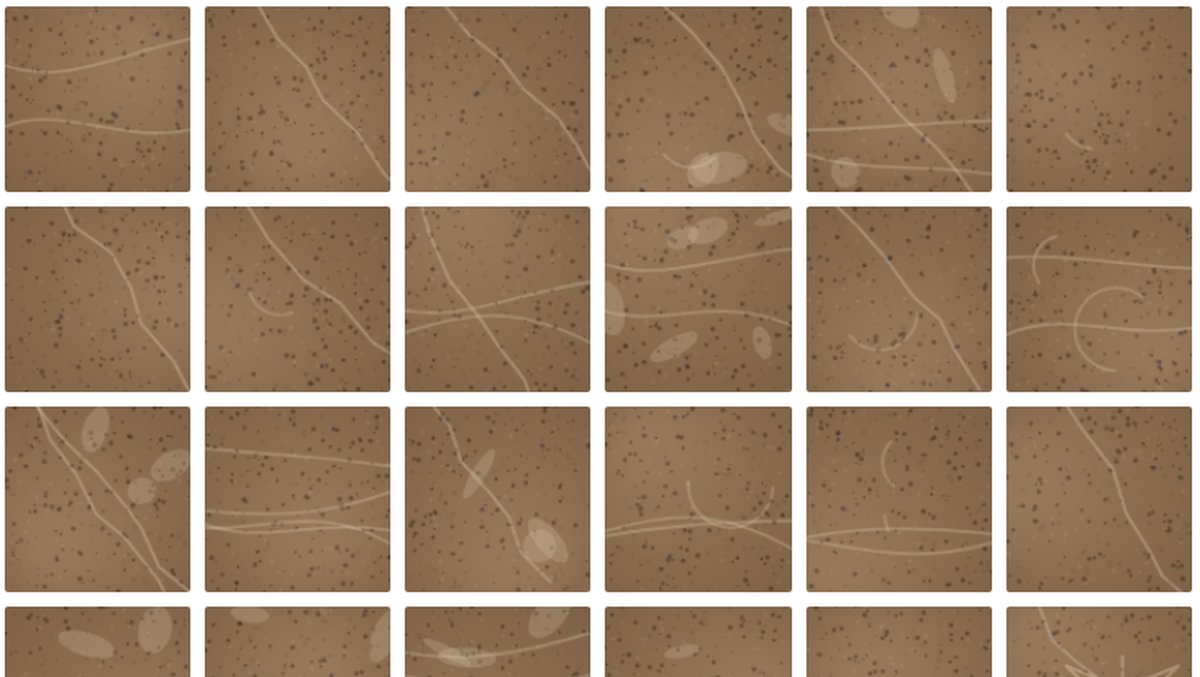
The page shows thirty-six squares of brown desert, scored with tracks and scattered with stones. One of them holds a drawing — a llama, a person or a bird, scraped into the ground in paler lines and almost lost among the decoys. Click a tile to look closer. Most people click several before they find it, and some give up.
The tiles are simulated. The ratio is not. In a survey published in 2024, a team led by Masato Sakai of Yamagata University, working with IBM Research, trained a model on aerial photographs of the Nazca desert in Peru. It had taken nearly a century to find 430 of the small, faint figures there. The model flagged 47,410 spots worth a look. Archaeologists screened them by eye and, in the paper's words, “processed an average of 36 AI-model suggestions to find one promising candidate.” Then they walked to the promising ones, and in six months of fieldwork confirmed 303 new figures, nearly doubling the count.
The work did not disappear; it moved. The screening took 1,200 hours and the walking 1,440. And the machine did not find everything: “the remaining 59 were found during the field survey without any help from AI.” Walking to the machine's suggestions put people in places they would not otherwise have been, and they kept their eyes open.
A Book That Cannot Be Opened
Half a world away, at Herculaneum, the problem is the opposite: the text is in hand and cannot be looked at. When Vesuvius erupted in AD 79 it carbonized a library in a villa there. More than 1,800 scrolls were found from 1752. The project now reading them calls it “a cruel bargain”: the scrolls survived “only by becoming too fragile to open. To read one was to destroy it.”
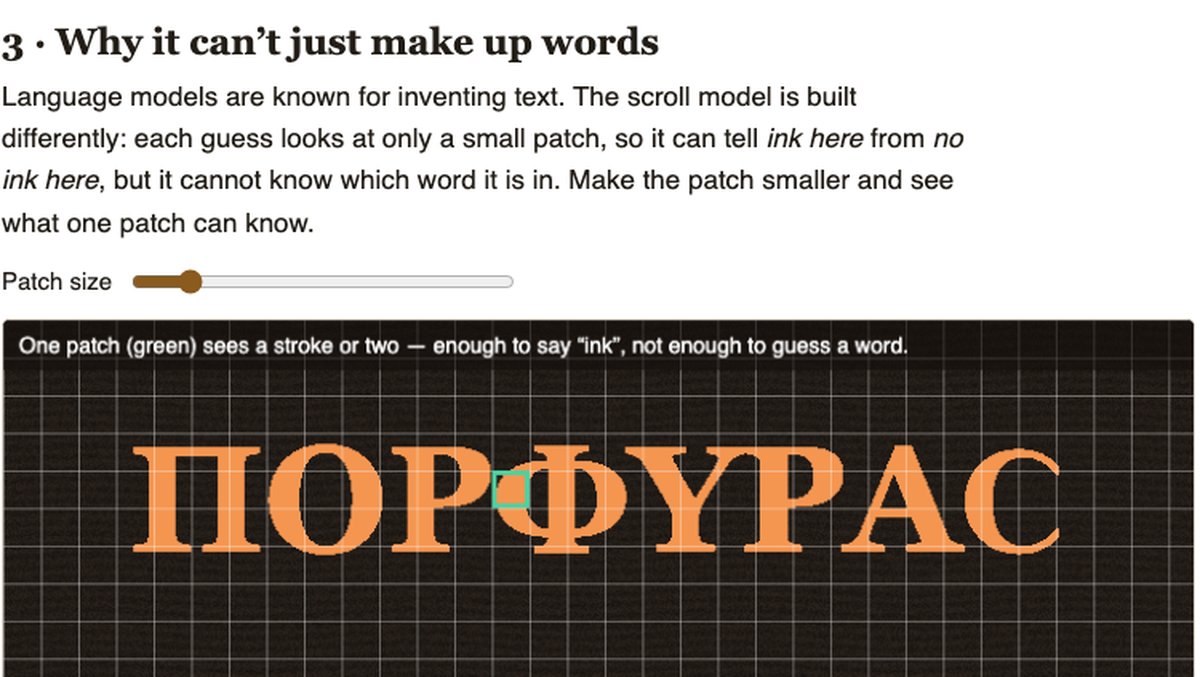
In June 2026 one of them was read end to end without being opened. It was scanned with X-rays, unrolled inside a computer, and searched for ink by a model. The obvious worry is that a model which finds letters might invent them. This one was built so that it cannot lean on which words are likely: each prediction sees only a small patch, which, in the 2026 preprint's words, makes “full-letterform hallucinations from linguistic or word-level priors practically impossible.” Papyrologists read and checked every line. And once, the check was physical: in an improved scan of another scroll, the ink became visible on its own, in the same place a model had found it in 2023.
That 2023 reading was the first word ever read from inside a closed Herculaneum scroll: ΠΟΡΦΥΡΑϹ, “purple,” found by a 21-year-old student in an open challenge. Most of the team that read the whole scroll three years later began as contestants.
A Neanderthal From 1963
The third result has no desert and no scroll. Two researchers, Matthew Magnani of the University of Maine and Jon Clindaniel of the University of Chicago, asked AI to describe and draw a day in the life of a Neanderthal, 100 times for each of four prompts. Then they did something unusual. They dated the answers, placing each one on a map built from 2,063 abstracts of Neanderthal scholarship published between 1923 and 2023.
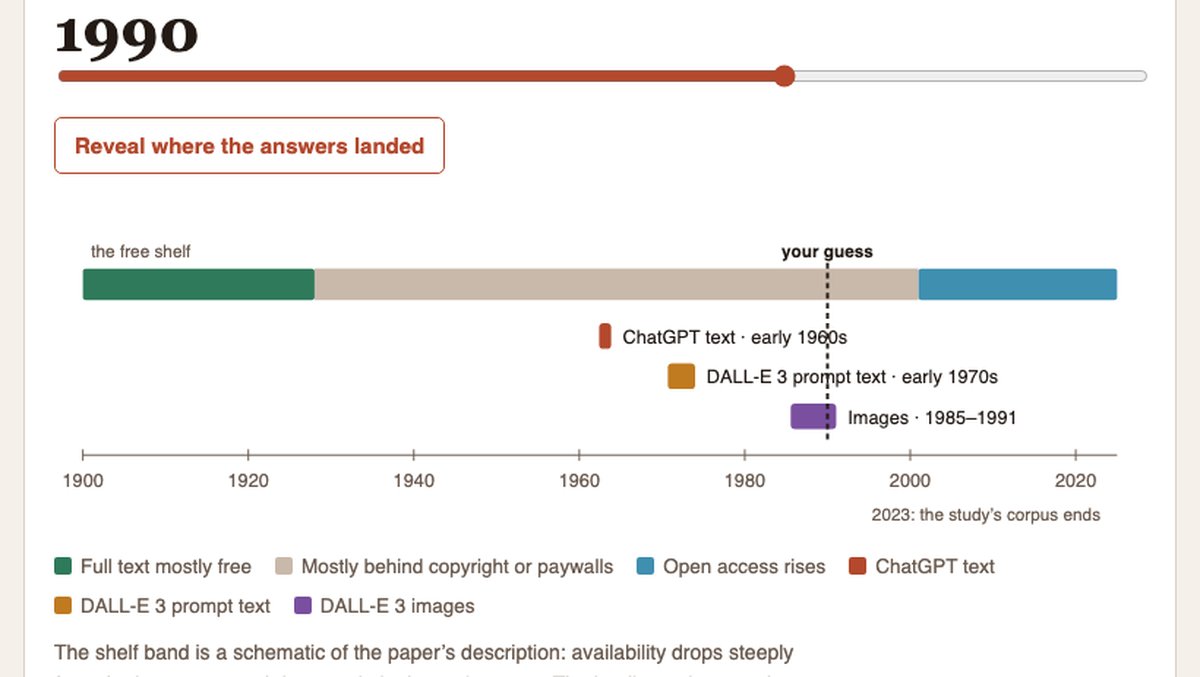
The written descriptions sat closest to the scholarship of the early 1960s. The pictures sat closest to the late 1980s and early 1990s, and showed something older still: stooped, hairy, heavily muscled men, almost no women or children, and glass vessels and metal tools in a world that had neither. The stoop goes back to a reconstruction published from 1911 to 1913. In 1957 the same bones were re-examined, and much of the stoop was traced to one man's arthritis.
The authors offer one reason, “at least partially”: what is free to read. When they tried to collect full-text articles for their map, only 378 were available, “the majority of which date to 1927 or earlier.” Copyright cut availability from the late 1920s, and recent research sits more often behind paywalls, so it is “less likely to feed into materials generated using AI.” The machine was not randomly wrong. It was wrong in a way that has a date, and the date follows the free shelf.
Three Jobs, Three Checks
Three problem playgrounds
Each opens the real thing
Finding
Thirty-six patches of desert. One holds a figure. Can you find it?
Peer-reviewed, PNAS 2024
Imagining
Which decade was the AI describing when it pictured a Neanderthal?
Peer-reviewed, 2025
Put side by side, the three results give the machine three different jobs. In Nazca it points, and people walk. At Herculaneum it sees ink, and people read. In the Neanderthal study it imagines, and nobody walks anywhere.
What separates them is not how good the model is. It is where the check happens. In the desert the check is a pair of feet: every one of the 303 figures was confirmed on the ground, and the walking found figures of its own. In the scroll the check is a papyrologist's eye and, once, the ink itself. For the Neanderthal there was no check built in at all. The only one came afterwards, from outside, from two researchers who thought to ask which decade the answers belonged to.
A machine extends what people can look at. It does not decide what anyone knows.
Where the looking ends in a check, the results hold. Where it ends in a picture, the picture is only as current as the shelf it was learned from.
What Is Easy to Reach
There is a quieter pattern underneath. The two results with a check built in are also the two that are open. The Nazca paper can be read in full for free, and the Herculaneum project publishes its scans for anyone to work on, which is how a student came to read the first word. The Neanderthal answers came from the other side of that line: from what was easy for a machine to reach, which turned out to be old.
The shape is not specific to archaeology. Any organisation that asks a model about itself will get answers drawn from whatever was easiest to reach — the old manual that circulated freely, rather than the decision made last month in a closed system. The answer will sound confident and complete. It will also have a date, and nobody will have asked what it is. This is the free shelf again, one building over.
Walking Still Finds Things
Finding got cheap. In Nazca a machine looked at the whole plain, something no team could do by eye. Confirming did not get cheap, and neither did reading a scroll line by line, or noticing that a description of the past belongs to the early 1960s. Those still run at the speed of people, and they are where the archaeology happens.
Back in the desert playground, the faint figure is still in one of the thirty-six tiles, and finding it still takes looking. The real survey found 59 figures that way, with no suggestion from the machine at all — by people who had been sent somewhere by a model and then kept their eyes open. Walking still finds things.